
 English
 Views: 0 Author: Site Editor Publish Time: 2026-07-21 Origin: Site


The structural integrity and corrosion resistance of a raw forging are not finalized at the press. They are dictated by the precision of the subsequent heat treatment. Procuring raw forgings without a rigorously defined thermal processing strategy leads to unpredictable mechanical properties. You will see intergranular corrosion, dimensional distortion, and ultimately, catastrophic component failure in high-stress environments. We see this often when buyers ignore the metallurgical realities of post-forge cooling. This guide provides a technical framework for evaluating the thermal processing of these components. We map specific thermal processes to alloy grades and establish strict vendor qualification criteria. You need these parameters to ensure component reliability. We will show you how to lock in the right microstructure before the parts ever reach your assembly line.
Alloy-Specific Processing: Thermal processing is not uniform; austenitic grades require precise solution annealing to prevent carbide precipitation, while martensitic grades rely on controlled quench-and-temper cycles for hardness.
Application-Driven Specifications: High-stress applications dictate heat treatment parameters. The thermal cycle for a standard structural bracket differs vastly from a pressure-retaining component in a corrosive environment.
Risk Mitigation: Distortion, scaling, and residual stresses are primary implementation risks. Evaluating a vendor's cooling media, furnace atmosphere controls, and quenching techniques is critical for procurement success.
Compliance & Traceability: Validating Material Test Reports (MTRs) against ASTM/ASME standards ensures the heat treatment yielded the required microstructural outcomes.
The "as-forged" condition of any metal is metallurgically unstable. Heavy plastic deformation during the forging process leaves the internal structure riddled with residual stresses and uneven grain sizes. When a stainless steel forging cools on the shop floor, it develops thermal gradients. These gradients create internal tension. Post-forge heat treatment establishes the baseline success criteria for the component. It initiates recrystallization and homogenizes the microstructure. It also controls grain size according to ASTM E112 standards. Proper thermal cycling dissolves detrimental phases, restores baseline corrosion resistance, and relieves internal forging stresses that cause warping during final machining.
We measure success by looking at the microstructure under a microscope. We want to see uniform grain boundaries. We do not want to see precipitated carbides or excessive secondary phases. The heat treatment must reset the metal. It erases the chaotic thermal history of the forging press and establishes a clean, predictable mechanical baseline.
Managing grain growth during thermal processing requires strict temperature control. You must avoid coarse grains that drastically reduce fatigue limits and impact toughness. If you leave a part in the furnace too long, the grains swell. This ruins the mechanical properties. In specific alloys, managing delta ferrite levels requires equal attention. Typically, maintaining delta ferrite between 3% to 8% (FN 3–10) balances weldability without compromising the material's inherent corrosion resistance. Precision control over the furnace environment ensures these microstructural targets are met consistently across the entire batch.
Shop floor operators use specific hold times based on the ruling section of the part. The ruling section is the thickest part of the forging. Heat must penetrate all the way to the core. If the core does not reach the target temperature, the microstructure remains heterogeneous. This leads to weak spots in the final component.
Specific thermal inputs directly dictate mechanical and chemical outputs. Heating rates prevent thermal shock in complex geometries. If you heat a massive flange too quickly, the outside expands faster than the inside. This causes thermal cracking. Soaking temperatures dictate phase transformations. Hold times ensure uniform heat penetration through the ruling section of the part. Finally, cooling rates lock in the desired microstructure. Adjusting these variables allows metallurgists to dial in exact yield strength, ductility, impact toughness, and pitting resistance requirements.
Thermal Inputs and Metallurgical Outcomes | ||
Thermal Input Variable | Direct Metallurgical Outcome | Field Performance Impact |
|---|---|---|
Controlled Heating Rate | Prevents internal thermal tearing | Eliminates catastrophic structural failure |
Target Soak Temperature | Dissolves carbides into solid solution | Restores maximum corrosion resistance |
Extended Hold Time | Homogenizes core microstructure | Ensures uniform yield strength |
Rapid Quench Rate | Prevents secondary phase precipitation | Maintains high impact toughness |
Inadequate heat treatment of stainless steel forgings carries severe operational and financial risks. Components suffer premature fatigue or stress corrosion cracking (SCC) in the field. Intergranular attack (IGA) destroys parts from the inside out. We see this when operators cut corners on soak times to save energy costs. Furthermore, improper thermal processing leads to massive batch rejections during non-destructive testing (NDT). This delays project timelines and inflates material costs. You end up scrapping thousands of pounds of expensive alloy simply because the furnace calibration was off by twenty degrees.
The primary process focus for austenitic stainless steel forgings is solution annealing. This involves heating the material above its critical temperature, typically between 1040°C and 1150°C (1900°F to 2100°F). This high heat dissolves chromium carbides back into the solid solution. The heating phase is immediately followed by rapid quenching. The primary implementation risk here is sensitization. If the metal cools too slowly through the critical sensitization range of 425°C to 815°C (800°F to 1500°F), chromium carbides precipitate at the grain boundaries. This depletes adjacent areas of chromium, leading to rapid localized corrosion. Evaluating conformance to ASTM A473 and ASTM A965 thermal processing guidelines prevents this failure mode.
We use massive water tanks to quench austenitic parts. The water must be agitated. Stagnant water creates a steam jacket around the hot forging. This steam jacket acts as an insulator and slows down the cooling rate. Agitation breaks the steam jacket and ensures rapid heat transfer. This is how we beat the sensitization curve.
Martensitic grades require austenitizing followed by controlled quenching in oil or air, and finally tempering. Ferritic grades typically undergo sub-critical annealing to restore ductility after forging. Engineers balance high tensile strength and hardness against the inevitable loss of ductility and impact toughness. Evaluating tempering temperatures avoids temper embrittlement zones. For example, you must strictly avoid the 475°C (885°F) embrittlement range in high-chromium phases. Hitting this temperature range severely degrades the material's toughness.
Load the martensitic forgings into a pre-heated furnace.
Ramp the temperature slowly to the austenitizing range (typically 950°C - 1050°C).
Hold at temperature for one hour per inch of cross-sectional thickness.
Quench rapidly in agitated oil to form martensite.
Transfer immediately to a tempering furnace before the parts cool to room temperature to prevent quench cracking.
Duplex steels require precise solution annealing between 1020°C and 1100°C, followed by a rapid water quench. This maintains the exact 50/50 ferrite-austenite phase balance. Slow cooling causes the formation of deleterious intermetallic phases, such as Sigma and Chi phases. These phases destroy corrosion resistance and make the metal brittle. For Precipitation-Hardening (PH) grades, you evaluate multi-step heat treatment pathways. This includes a solution treatment followed by specific aging cycles, like H900 or H1150 conditions. These aging cycles precipitate copper or aluminum compounds within the metal matrix, achieving exact yield strength, fracture toughness, and hardness targets.
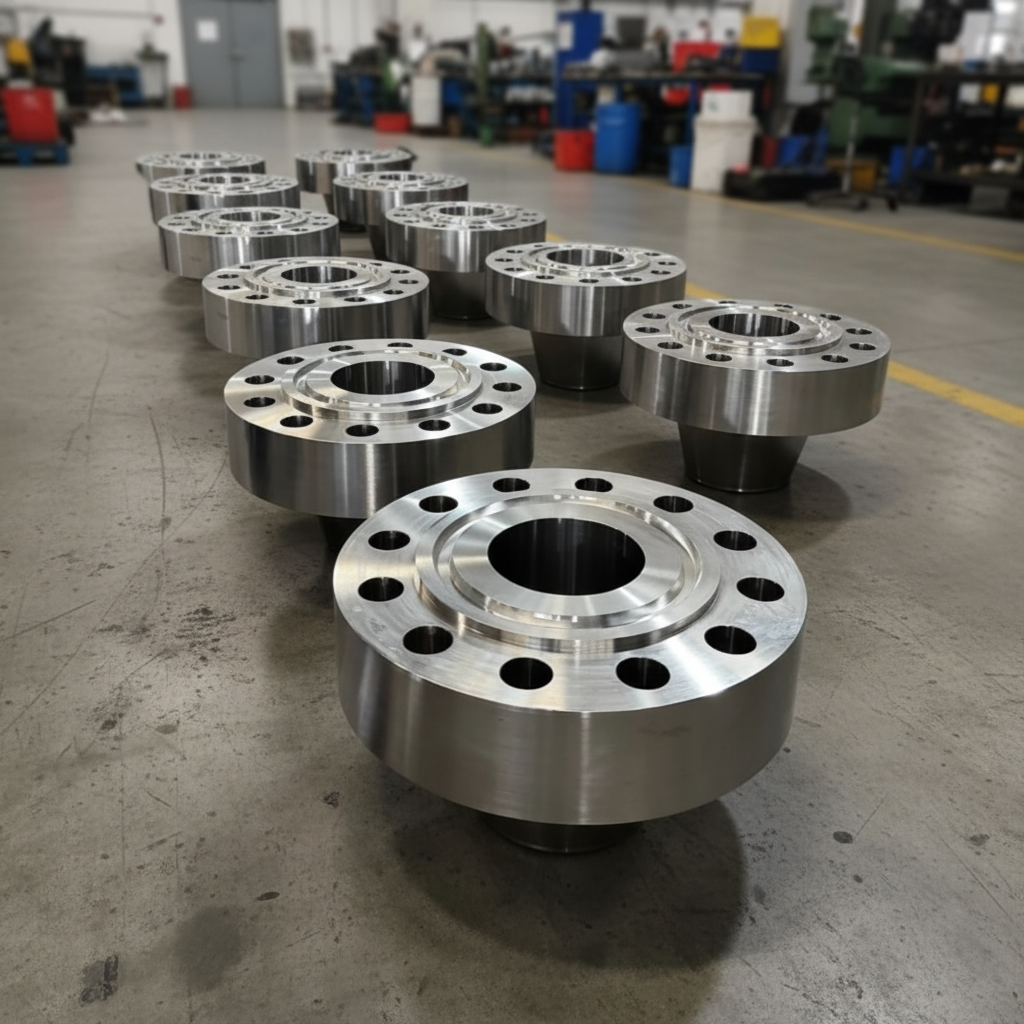
When processing custom stainless steel forgings, furnace temperature uniformity is paramount. Soak time calculations rely on the maximum cross-sectional thickness. We call this the ruling section. Thermal ramp rates require strict control to prevent thermal shock and cracking in complex geometries. Atmospheric control is also necessary. Protective atmospheres using argon, nitrogen, or vacuum environments prevent heavy surface scaling and surface carbon depletion during high-temperature cycles.
We often use car-bottom furnaces for large custom parts. The entire floor of the furnace rolls out on tracks. We load the heavy forgings onto the car using overhead cranes. We space the parts out carefully. If parts touch each other, they create cold spots. The heat must circulate freely around every single component to ensure uniform annealing.
Quenching locks in the metallurgical properties achieved during heating. Common solution categories include water, oil, polymer quenchants, and forced air. Selecting the right quenching media depends on alloy hardenability, section size, and required heat transfer coefficients. A rapid water quench works well for austenitic grades, but it causes severe distortion or quench cracking in complex martensitic parts. You mitigate the risk of thermal distortion and high residual stresses through careful media selection and agitation control.
Quenching Media Comparison | |||
Quench Media | Cooling Rate | Typical Alloy Application | Primary Risk Factor |
|---|---|---|---|
Agitated Water | Extremely Fast | Austenitic, Duplex | Severe distortion in thin sections |
Quench Oil | Moderate | Martensitic, Low-Alloy | Fire hazard, environmental disposal |
Polymer Solution | Adjustable | Complex Custom Geometries | Requires strict concentration monitoring |
Forced Air | Slow | High-Hardenability Tool Steels | Scaling and oxidation |
Sub-critical stress relief applies to custom parts prior to final machining. This process typically occurs between 290°C and 400°C. It ensures strict dimensional stability by relaxing internal stresses generated during the forging and initial cooling phases. You keep the temperature low enough to avoid risking carbide precipitation. If you machine a part with high residual stress, it will warp as soon as you remove material from the surface. Stress relieving prevents this costly machining error.
High-temperature heat treatment inevitably forms a depleted chromium layer under the oxide scale. This surface problem requires remediation before the part enters service. Mandatory chemical pickling uses acid baths containing nitric-hydrofluoric acid per ASTM A380. This removes the scale and the depleted layer. Chemical passivation per ASTM A967 follows immediately. Passivation restores the protective passive chromium oxide layer. Without this step, the forging will rust in the field, regardless of its internal alloy composition.
Shell-and-tube or plate heat exchangers operate in brutal environments. Chemical processing, petrochemical plants, and marine environments demand flawless thermal processing for all pressure-retaining components. A single microstructural flaw in a flange leads to a catastrophic leak. This causes plant shutdowns and severe safety hazards. We do not take chances with pressure vessel components.
The F317L grade features low carbon (maximum 0.030%) and high molybdenum (3.0% to 4.0%). The low carbon content shifts the sensitization curve. This allows safer handling and slightly slower cooling rates during quenching without risking carbide precipitation. However, the high molybdenum content increases the material's susceptibility to secondary phase formation. Specifically, the brittle Sigma phase forms if cooling is delayed. Precision in the thermal cycle remains non-negotiable.
Strict solution annealing of a forged F317L stainless steel flange for heat exchanger applications occurs at a minimum of 1040°C (1900°F). Rapid water quenching follows immediately. Adherence to industry codes is mandatory. Facilities comply with ASTM A182/A182M specifications for forged fittings and valves for high-temperature service. Furthermore, components meet the stringent requirements of the ASME Boiler and Pressure Vessel Code (BPVC) Section II and VIII. Inspectors check the furnace charts against these codes before signing off on the batch.
Proper thermal processing guarantees leak-tight structural integrity. It maximizes resistance to chloride pitting, ensuring a Pitting Resistance Equivalent Number (PREN) calculation greater than 30. This meticulous heat treatment ensures component longevity under severe thermal cycling and exposure to aggressive, acidic media. When we pull a properly treated F317L flange from the quench tank, we know it will survive decades of chemical exposure.
Scalability and control dictate vendor selection. A forging supplier with integrated, in-house heat treatment offers significant advantages. It provides a single chain of custody, reduces transport damage risks, and allows for immediate metallurgical feedback between the forge and the furnace. If a part cracks during quenching, the metallurgist walks over to the forging press and adjusts the forging temperature immediately. Outsourced thermal processors require much stricter oversight and auditing to ensure compliance.
Evaluate vendor pyrometry and equipment calibration rigorously. They adhere to AMS 2750 specifications. Look for Class 2 furnaces with a +/-5°C tolerance for critical parts. Request documentation for System Accuracy Tests (SAT) and Temperature Uniformity Surveys (TUS). Verify compliance with ASTM A473, ASTM A965, and NACE MR0175/ISO 15156 for sour service environments. Always review furnace chart recordings, thermocouple calibration logs, and test coupons processed alongside your actual forging batch.
Request the latest TUS report for the specific furnace used for your parts.
Verify the calibration dates on all load thermocouples.
Check the quench tank agitation system maintenance logs.
Review the material test reports (MTRs) for accurate heat treatment parameters.
Distortion control remains a primary implementation risk. Evaluate the vendor's fixturing, support tooling, and racking methods during high-temperature cycles to minimize gravity-induced warping. Mandate specific post-treatment verification testing. This includes ultrasonic testing (ASTM A388/A745) and liquid penetrant testing (ASTM E165). Destructive testing, such as Charpy V-notch impact testing, tensile testing, and ASTM A262 Practice A or E intergranular corrosion testing, validates the true efficacy of the thermal processing.
Heat treatment dictates the metallurgical viability of any forged component. Procurement and engineering teams select partners based on their demonstrated control over thermal processing variables. You cannot inspect quality into a part after a bad heat treatment; you must control the process from the start.
Audit your current suppliers' furnace calibration logs and AMS 2750 compliance records.
Specify exact cooling rates and quenching media in your purchase orders.
Require destructive test coupons to be processed in the same furnace load as your critical production parts.
Implement mandatory post-heat treatment surface passivation protocols.
A: Solution annealing dissolves chromium carbides that form during the forging process back into the solid metal matrix. Rapid quenching then traps these carbides in solution, preventing sensitization and restoring the material's maximum corrosion resistance.
A: Quench cracking occurs when the thermal gradients and phase transformation stresses during rapid cooling exceed the material's tensile strength. Using a less drastic quenching medium, like oil instead of water, helps mitigate this risk.
A: A controlled amount of delta ferrite (typically 3-8%) improves the weldability of austenitic stainless steels and reduces susceptibility to hot cracking. However, excessive delta ferrite degrades corrosion resistance and toughness.
A: Stress relieving removes internal residual stresses generated during forging and rapid cooling. This prevents the component from warping or distorting out of tolerance when material is removed during final precision machining.
A: F317L contains higher molybdenum content (3.0-4.0%) compared to 316L. This significantly increases its resistance to chemical attack and chloride pitting, making it superior for aggressive heat exchanger environments.
A: A TUS is a standardized test that maps the temperature distribution within a heat treatment furnace. It ensures that all parts within the furnace working zone experience the exact same thermal conditions, guaranteeing batch consistency.


