
 English
 Views: 0 Author: Site Editor Publish Time: 2026-09-01 Origin: Site


In critical engineering sectors like aerospace, energy generation, and petrochemical refining, material failure is catastrophic. Engineers and procurement teams face immense complexity when specifying material grades and testing protocols. You must ensure regulatory compliance, structural integrity, and supply chain traceability. Navigating these requirements demands strict adherence to established metallurgical standards. A single deviation in heat treatment or reduction ratio can compromise a pressure vessel or turbine blade. This guide provides a definitive framework for understanding ASTM specifications. We break down how to evaluate testing requirements and select a compliant forging partner for high-stakes applications. You will learn the exact parameters needed to verify mechanical properties and avoid catastrophic yielding in the field.
Baseline Compliance: ASTM A473 serves as the foundational specification for general-use austenitic, ferritic, and martensitic forgings, while ASTM A182 governs high-temperature and pressure-containing components.
Age-Hardening & Aerospace Specifics: High-stress aviation components require stringent adherence to specialized processes governed by ASTM A705 and AMS equivalents, such as the 13-8PH forging process for aerospace parts.
Verification is Mandatory: Quality assurance relies heavily on standardized testing protocols, including ASTM A370 (mechanical) and ASTM E23 (impact), to validate the structural integrity of the forging.
Vendor Evaluation: Selecting a forging partner requires assessing their capability to maintain strict heat lot traceability from raw stock (e.g., ASTM A276) to final product, and execute required non-destructive examinations (NDE) in-house or via certified third parties.
ASTM standards establish the absolute baseline for chemical composition, heat treatment, and mechanical properties. They remove ambiguity from the manufacturing floor. You cannot rely on generic material requests. You must use application-specific standard callouts to prevent premature fatigue or corrosion. A standard like ASTM A473 dictates exact chromium, nickel, and carbon percentages. This ensures the material performs predictably under mechanical stress.
These standards dictate acceptable reduction ratios. When a facility heats a billet to 2100°F, the internal structure becomes plastic. A proper reduction ratio, typically a minimum of 3:1, ensures internal voids close during the stainless steel forging process. This deformation consolidates centerline porosity from the original cast ingot. Grain flow requirements are equally strict. Standards specify how the grain structure must align with the component's primary stress axes. Proper grain flow maximizes directional strength and impact resistance. Without these standardized criteria, forged components risk unpredictable failure under cyclic loading.
Utilizing non-certified or loosely specified forgings introduces severe operational risks. Poorly controlled heat treatments lead to intergranular corrosion. If a vendor fails to quench an austenitic stainless steel fast enough, chromium carbides precipitate at the grain boundaries. This depletes the surrounding area of chromium, leading to rapid localized corrosion in service. Inadequate forging reduction causes catastrophic yielding under pressure. ASTM standards mitigate these risks by enforcing strict process controls. Every step of the thermal and mechanical cycle must meet documented parameters.
Material Test Reports (MTRs) serve as the primary verification tool. ASTM standards enforce unbroken heat lot traceability. This traceability starts from the raw billet or forging stock. Facilities verify raw materials against standards like ASTM A276 or A479. The documentation follows the material through heating, forging, heat treatment, and final machining. If a flange cracks during hydro-testing, engineers pull the MTR to trace the exact chemical heat and processing history. This allows teams to identify the root cause and quarantine any other parts from that specific heat lot.
ASTM A473 covers a broad spectrum of materials. It includes austenitic, austenitic-ferritic (duplex), ferritic, and martensitic stainless steel forgings. This standard serves as the default specification for general-use applications. It defines the chemical and mechanical requirements for parts that do not face extreme pressure or temperature extremes.
Common grades under this standard include 304/304L, 316/316L, and 321. These grades map directly to general structural requirements. The "L" designation indicates lower carbon content (maximum 0.03%), which improves weldability by reducing the risk of sensitization. Ideal use cases include structural supports, base plates, general machinery components, and low-to-moderate temperature environments. You should specify A473 for standard structural needs. Upgrade to pressure-vessel or high-temperature standards only when operational environments demand strict pressure boundary integrity.
ASTM A182 governs forged fittings, flanges, and valves. It specifically targets components intended for high-temperature service and pressure-containing systems. This standard is non-negotiable for petrochemical pipelines, offshore platforms, and power generation boilers. It enforces much stricter controls than A473.
Heat treatment and mechanical testing requirements under A182 are highly specific. The standard dictates exact solution annealing temperatures and rapid quenching protocols. For example, F316 requires solution annealing above 1900°F followed by a rapid water quench. This prevents carbide precipitation at the grain boundaries. Evaluating A182 involves trade-offs. Compliance increases raw material costs and extends lead times due to the rigorous testing requirements. However, this investment is mandatory. The necessity for absolute pressure boundary integrity outweighs the initial procurement costs.
ASTM A565 applies to martensitic stainless steels. These materials require high strength and oxidation resistance at elevated temperatures. Unlike austenitic grades, martensitic steels can be hardened through heat treatment. This makes them ideal for high-wear, high-heat environments.
Common grades covered include 410, 416, 420, and 422. Engineers specify these grades for power generation equipment. Typical applications include steam turbine blades, compressor discs, and high-temperature fasteners. The standard dictates precise tempering cycles. These cycles balance tensile strength with necessary fracture toughness. A565 ensures the material retains its mechanical properties even after prolonged exposure to extreme heat, preventing creep deformation over thousands of operating hours.
ASTM A705 is the critical standard for precipitation-hardening (PH) stainless steel forgings. Common grades include 17-4PH and 15-5PH. These materials offer a unique combination of high strength and excellent corrosion resistance. They are heavily utilized in aerospace, defense, and marine applications.
This standard dictates complex thermal processing. It requires a specific solution annealing phase (Condition A) followed by precise aging treatments. The aging temperature determines the final mechanical properties. Aging at 900°F (Condition H900) maximizes ultimate tensile strength and yield strength. Aging at 1150°F (Condition H1150) improves ductility and impact toughness while slightly reducing overall strength. A705 ensures manufacturers achieve exceptionally high strength-to-weight ratios without compromising structural stability.
ASTM Standard | Material Types Covered | Primary Application Focus | Key Heat Treatment Requirement |
|---|---|---|---|
ASTM A473 | Austenitic, Ferritic, Martensitic, Duplex | General structural, low-to-moderate temp | Standard annealing and cooling based on grade. |
ASTM A182 | Austenitic, Ferritic, Martensitic, Duplex | High-temperature, pressure-containing parts | Strict solution annealing and rapid liquid quenching. |
ASTM A565 | Martensitic (410, 416, 420, 422) | Power generation, turbine components | High-temperature tempering for creep resistance. |
ASTM A705 | Precipitation-Hardening (17-4PH, 15-5PH) | Aerospace, high strength-to-weight ratio | Solution annealing followed by specific age-hardening. |
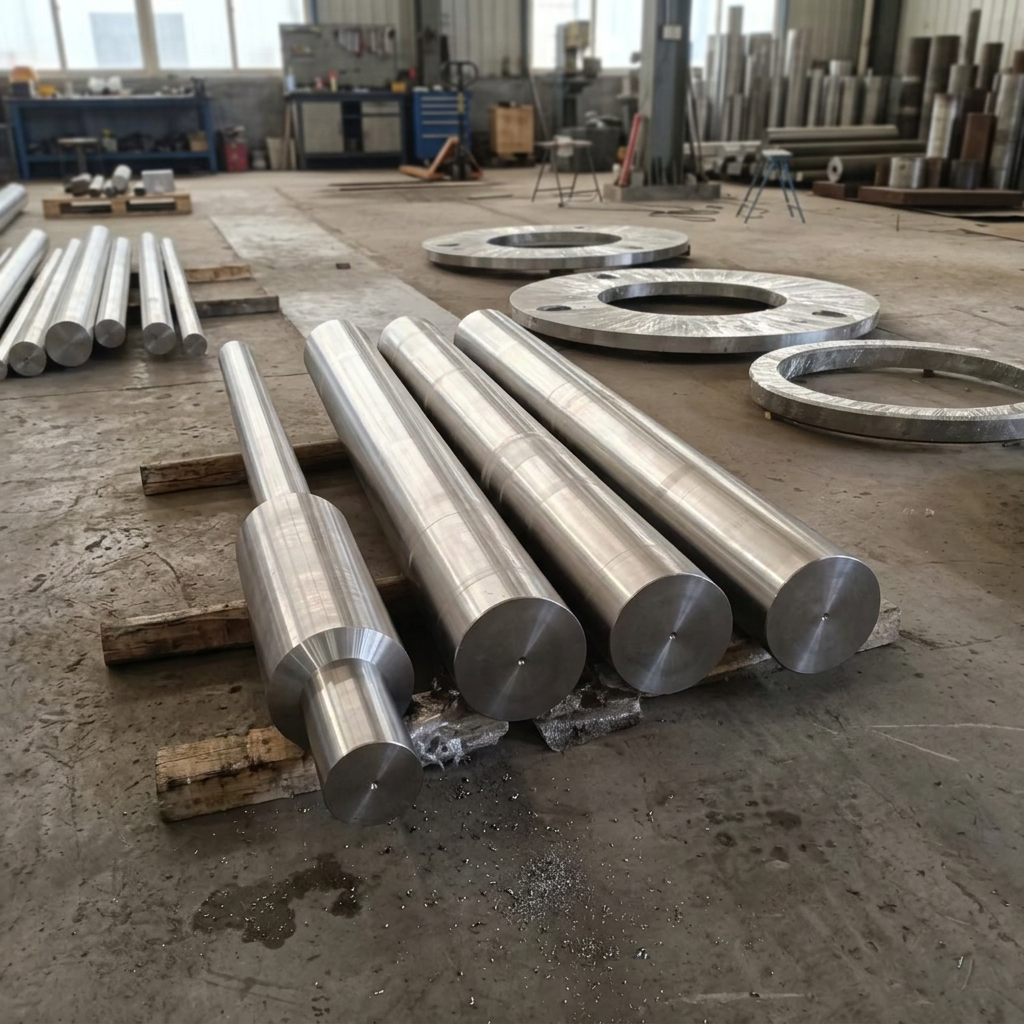
Aerospace manufacturing requires standards that exceed general industrial specifications. There is significant overlap between ASTM standards and Aerospace Material Specifications (AMS). ASTM A705 provides the baseline for precipitation-hardening forgings. However, AMS specifications add layers of microstructural control. AMS dictates tighter chemistry limits and stricter non-destructive testing.
A compliant Aviation Stainless Steel Forging Process integrates these requirements. It uses ASTM for baseline mechanical testing. It relies on AMS for stringent microstructural evaluation. AMS standards often require macroetch testing per ASTM E381 to verify grain flow and check for segregation, freckles, or white spots. They also mandate specific inclusion ratings to ensure material cleanliness. Manufacturers must navigate both standard sets to produce flight-critical hardware.
Aeroengine blades operate under extreme centrifugal forces and thermal stress. The S41428 Forging Process for Aeroengine Blades requires exact metallurgical controls. S41428 is a highly specialized martensitic grade. It demands precise temperature control during the forging cycle. If the forging temperature drops too low, the material risks internal cracking. If it gets too hot, grain growth occurs, destroying fatigue life.
Critical evaluation focuses on grain size control. Fine grain structures (typically ASTM No. 5 or finer) are mandatory for fatigue resistance. The process also enforces strict delta ferrite limits. Excessive delta ferrite acts as a stress riser, causing embrittlement and reducing transverse ductility. Ultrasonic testing (UT) requirements for these rotating components are severe. Technicians must scan every blade using flat bottom hole (FBH) calibration blocks to detect subsurface anomalies that could propagate into catastrophic fractures during engine operation.
The 13-8PH Forging Process for Aerospace Parts presents unique manufacturing challenges. This alloy is a martensitic precipitation-hardening stainless steel. It offers excellent transverse toughness and high strength. Both ASTM A705 and specific AMS standards govern its processing. The alloy requires vacuum induction melting (VIM) followed by vacuum arc remelting (VAR) to ensure absolute purity and minimize non-metallic inclusions.
Forging 13-8PH is difficult. The material has a narrow hot-working temperature range. Strict temperature control is required to prevent surface tearing and internal cracking. Operators must stop forging and reheat the billet if the temperature falls below the minimum working limit. Standards dictate the exact solution annealing and aging processes. These thermal cycles precipitate intermetallic compounds within the martensitic matrix. This controlled precipitation achieves the optimal balance of yield strength and fracture toughness required for landing gear and structural airframe components.
Mechanical testing validates the physical capabilities of the forged component. ASTM A370 and ASTM E8 outline the exact procedures for tensile testing. These tests verify yield strength, ultimate tensile strength, and elongation. Yield strength indicates the point of permanent deformation. Ultimate tensile strength measures the maximum stress before failure.
ASTM A370 dictates the precise orientation and location of test specimens. Technicians extract specimens relative to the forging's grain flow. We often leave a "prolongation" on the forging—an extra length of material that undergoes the exact same thermal cycles as the part. Testing in the longitudinal direction often yields higher strength values. Transverse testing reveals the material's weakest orientation. Standards require testing in specific directions to ensure the component can withstand multi-axial operational loads.
Material toughness is critical, especially in low-temperature environments like offshore platforms or cryogenic storage. ASTM E23 details the Charpy V-notch impact test. A pendulum strikes a notched specimen to measure the energy absorbed during fracture. High energy absorption indicates good ductility and toughness. Low absorption warns of brittle behavior. We frequently test specimens at -50°F or lower to verify low-temperature performance.
Hardness testing provides a rapid, non-destructive proxy for material strength. ASTM E18 governs Rockwell hardness testing, while ASTM E10 covers Brinell testing. Technicians use Brinell (HBW) for large, rough forgings and Rockwell (HRC) for machined surfaces. We use these tests to verify uniform heat treatment across complex forged geometries. Consistent hardness readings confirm that the entire part reached the required temperature and cooling rate during the thermal cycle.
Non-Destructive Examination (NDE) detects flaws without damaging the final product. ASTM forging specifications frequently append standard NDE methods. ASTM E165 governs Liquid Penetrant Examination (PT). PT detects surface-breaking defects like cracks, laps, and porosity. ASTM A388 dictates Ultrasonic Examination (UT). UT uses high-frequency sound waves to locate internal voids, bursts, and inclusions.
Deciding which NDE methods to specify depends on component criticality and geometry. Use this framework:
Visual inspection and dimensional verification for low-stress structural supports.
Liquid Penetrant (PT) or Magnetic Particle (MT) for surface defect detection on machined faces.
100% Volumetric Ultrasonic Testing (UT) per ASTM A388 for high-pressure or aerospace components.
Radiographic Testing (RT) for complex geometries where UT cannot penetrate varying cross-sections effectively.
Selecting a forging supplier requires a rigorous audit of their Quality Management System (QMS). Request current ISO 9001 certificates for general industrial applications. For aviation components, AS9100 certification is strictly mandatory. These certifications prove the vendor maintains documented, repeatable processes and controls their supply chain effectively.
Evaluate their testing infrastructure. Suppliers with in-house metallurgical laboratories offer significant advantages. They perform rapid ASTM compliance verification. This includes real-time chemical analysis via optical emission spectroscopy (OES) and mechanical testing. Reliance on external testing facilities introduces supply chain delays. It also complicates the chain of custody for critical test specimens. Ensure the vendor's internal lab holds ISO/IEC 17025 accreditation for testing competence.
Procurement teams often struggle with standard specification. Over-specifying standards drives up costs unnecessarily. Demanding ASTM A182 testing and UT inspection for a non-pressure A473 structural bracket wastes budget. It extends manufacturing lead times without adding functional value. Match the specification strictly to the engineering requirement.
Under-specifying carries massive hidden costs. Non-compliance leads to delayed project timelines and failed regulatory audits. Component rework destroys profit margins. Substituting a standard 304 grade for 316L in a highly corrosive environment guarantees premature failure. The cost of a field failure, including downtime and liability, always exceeds the initial price premium of specifying the correct ASTM standard and testing protocol.
Successful stainless steel forging procurement relies on precision. You must match the exact ASTM specification to the operational environment. Whether utilizing A473 for structural parts, A182 for pressure vessels, or A705 for aerospace components, the standard dictates the survival of the part. Selecting a vendor requires proven adherence to these standards. Look for robust NDE capabilities and transparent MTR documentation from raw stock to the final machined part.
Take the following actions to ensure compliance and structural integrity:
Audit your current engineering drawings to ensure they reference specific, up-to-date ASTM or AMS standards rather than generic material names.
Consult with a qualified metallurgist to optimize your standard callouts, ensuring you do not over-specify or under-specify testing requirements.
Develop a standardized Request for Quote (RFQ) template that explicitly lists all required mechanical, impact, and NDE testing parameters.
Request sample Material Test Reports (MTRs) from prospective vendors to verify their heat lot traceability processes before awarding contracts.
A: ASTM A473 is the standard specification for general-use stainless steel forgings. It covers austenitic, ferritic, martensitic, and duplex grades. Engineers specify A473 for structural components and machinery operating in low-to-moderate temperature environments where extreme pressure containment is not required.
A: ASTM A473 is for general structural applications. ASTM A182 specifically governs high-temperature and pressure-containing components like flanges, fittings, and valves. A182 mandates much stricter heat treatment controls and mechanical testing protocols to ensure absolute pressure boundary integrity and prevent carbide precipitation.
A: ASTM A705 covers age-hardening and precipitation-hardening stainless steel forgings. This standard dictates the complex solution annealing and aging treatments required for grades like 17-4PH and 15-5PH. It ensures the material achieves exceptionally high strength-to-weight ratios for aerospace and defense applications.
A: Mechanical quality is verified using ASTM A370 and ASTM E8 for tensile testing to check yield strength, ultimate tensile strength, and elongation. Toughness is tested via ASTM E23 using Charpy V-notch impact tests. Hardness is verified using ASTM E18 or ASTM E10 to confirm uniform heat treatment.
A: The 13-8PH forging process is governed by ASTM A705 for baseline precipitation-hardening requirements. Specific Aerospace Material Specifications (AMS) also apply. These dictate strict microstructural controls, vacuum melting requirements (VIM/VAR), and precise temperature windows to prevent cracking during the forging cycle.
A: While ASTM standards provide the baseline for chemical and mechanical properties, they are rarely sufficient alone for aviation. Aerospace Material Specifications (AMS) are typically required. AMS adds stringent microstructural controls, tighter chemistry limits, and mandatory non-destructive testing critical for flight safety.
A: ASTM A370 dictates the exact procedures for mechanical testing of steel products. In forging, it specifies the orientation and location of test specimens relative to the component's grain flow. This ensures tensile and impact tests accurately reflect the material's directional strength under operational loads.


